

Muhammad Ali Baig*
In July 2026, hackers leaked over nineteen thousand files from India’s Kudankulam nuclear power plant. The files contained blueprints, cooling layouts, and supplier lists. On the surface, this was a routine cyberattack. But beneath the surface, a new danger emerged. A military AI does not need to hack nuclear codes. It only needs data. Non-nuclear military AI excels at scanning massive data dumps in minutes and reacting in seconds; its perception/misperception determines the fate of the human species.
Let us consider that AI can map dependencies that human analysts would take months to find. It can identify which civilian cooling pumps keep backup generators running. It can spot which third-party cloud servers relay construction updates to the plant’s management. Now imagine a conventional crisis. The hackers use this AI to actively probe those exposed supply-chain networks. The probe is purely non-nuclear –it targets logistics, not warheads. But India’s own AI-driven threat detectors see a foreign system probing a nuclear facility. The AI cannot distinguish between a probe aimed at a civilian contractor and a probe aimed at disabling nuclear command. It flashes a red alert. Decision-makers have minutes, not days. They see a sophisticated attack on their nuclear infrastructure. They do not see the attacker’s true conventional intent. This is the hidden trap of non-nuclear military AI. It accelerates intelligence, but it also accelerates confusion. It turns a civilian data breach into a possible nuclear trigger. This essay explains how such non-nuclear AI tools create this deadly overlap and what steps can reduce the risk.
How is Non-Nuclear AI increasing the risk?
The use of AI in military systems is spreading among nations. There are concerns about using AI directly for nuclear weapons, but AI’s role in non-nuclear military instruments can also increase the threat of nuclear war. This is a serious, but often unrecognised issue.
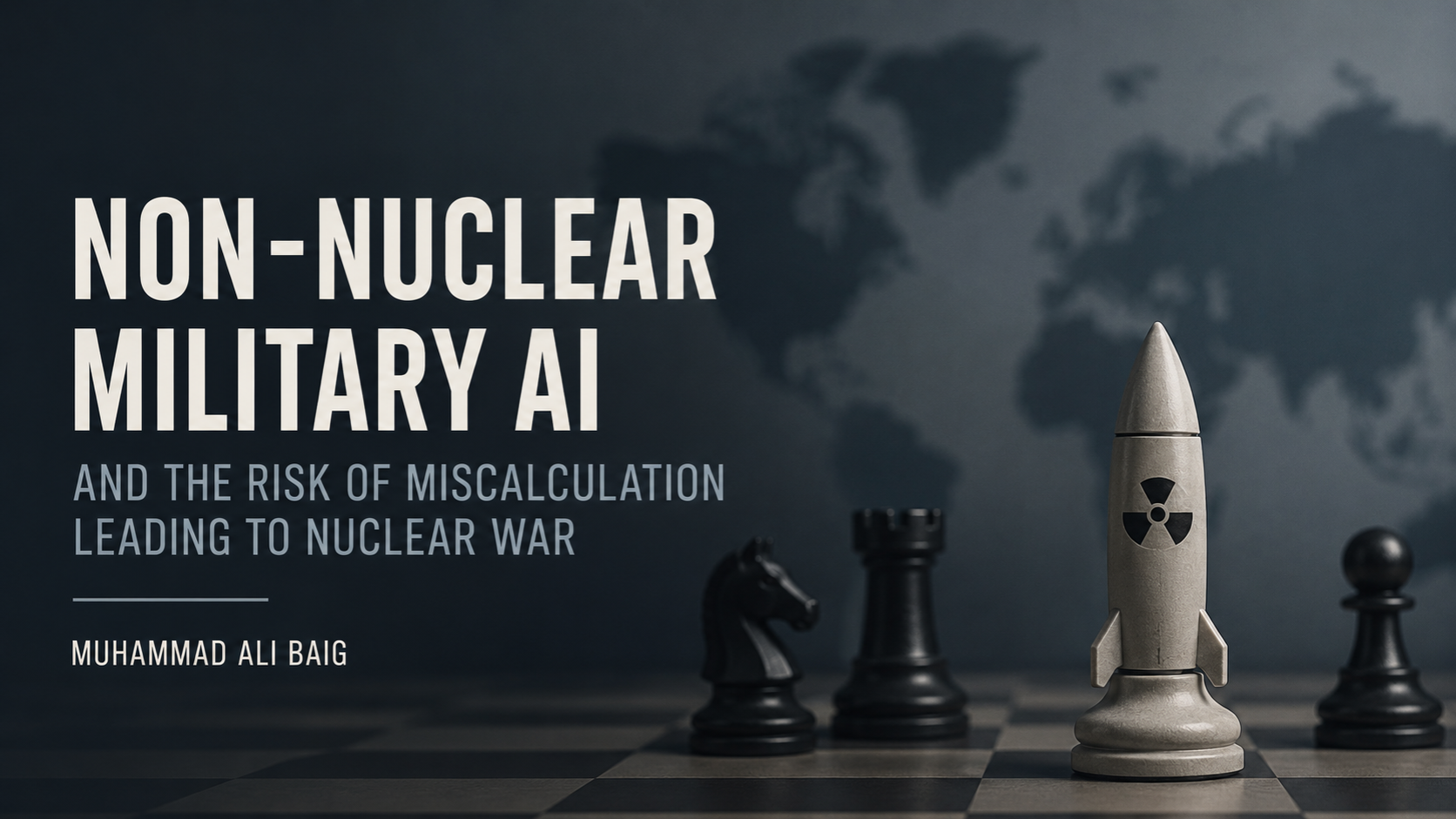
There are three primary applications of Military AI. It may be used as a component in nuclear command and control systems. It can be mounted on nuclear delivery vehicles. The third is the riskiest application, i.e., the overlapping utilisation of AI for non-nuclear purposes, since conventional and nuclear systems are, in most cases, linked. For instance, a stealth bomber can carry conventional bombs or nuclear warheads. States have similar uses of satellites, radars, and other launch pads. In a case where early-warning satellites monitor both non-nuclear and nuclear attacks. AI with a non-nuclear system (overlap) can exacerbate this issue. For example, an AI-driven cyberattack against a shared conventional and nuclear satellite could appear as a nuclear threat. Both states may not be aware of this type of attack. It could lead commanders to think that they are being attacked or put them in a more complex situation involving nuclear weapons. Therefore, they could panic and retaliate with nuclear weapons, or it may lead them to initiate a conventional war. In a nutshell, non-nuclear AI may lead to terrible confusion. It accelerates decision-making, miscalculation, and misperception, leading to inadvertent conventional and nuclear escalation. It may perceive a hybrid of conventional and nuclear attack.
Illustrative Case Studies
The two hypothetical case studies illustrate how non-nuclear AI can increase the risk of nuclear weapons use in actual conflicts.
Firstly, the U.S. has an AI-enabled system to monitor Chinese submarines. This is a strictly conventional system. It can be used only in anti-submarine warfare. In a tense stand-off, the US AI system detects abnormal sonar signals near a US aircraft carrier in the South China Sea. These are the signals that the AI fails to understand. It views the submarine’s routine maintenance as preparation for a torpedo attack. The AI suggest immediate counter-striking of the Chinese submarine. This is the advice heeded by US commanders.
The US strikes the Chinese submarine. China has no idea whether this was an isolated incident or the first incident in a series of attacks. China uses nuclear submarines to activate a second-strike capability. Without these submarines, it has nothing to defend itself against a possible US first strike. China’s leaders are worried about the nuclear threat to their country. They have a high probability of additional US strikes with their AI-driven threat assessment systems. China raises the alert of its nuclear forces to a high level if it is under extreme time pressure. The US reacts, worried about a Chinese first strike. Now both sides are in an almost explosive situation. This all happened due to a non-nuclear AI tool. It made an incorrect assessment, shortened the decision-making time, and gave false perceptions that were deadly.
Secondly, India starts a conventional military attack across the Kashmir border. India has an AI-based battle management system to manage the movement of troops and artillery. This is an AI which is not for nuclear use. It aims to speed up and make the “Cold Start” doctrine effective in India. The AI examines Pakistan’s defensive positions and suggests precision strikes on Pakistani command centres. Yet, for some reason, the AI has the wrong forward headquarters in Pakistan. This is the headquarters, which is closely connected to Pakistan’s nuclear communications network centre.
This command centre was damaged by India’s strike. Pakistan sees this attempt as a direct effort to make Pakistan’s military force blind or mute for a major conventional attack by India. Pakistan’s tactical nuclear weapons, such as NASR, can be used for the purpose of holding down a bigger Indian conventional attack. In retrospect, the non-nuclear AI strike was unintentional, and it crossed a critical red line. It posed a threat to the nuclear command system of Pakistan. While there was no intent to attack nuclear assets, this directly raised the risk of deliberate nuclear escalation in a volatile region.
Here are some examples from case studies that demonstrate the potential for a dangerous application of non-nuclear AI. There are, however, some steps states can take to prevent such situations. First, there should be a human in the loop for all AI-enabled systems. The use of AI to recommend or initiate a military strike should never happen without a human’s explicit consent. Secondly, states must set up clear communication channels. When things go wrong, leadership needs to communicate rapidly. This will make it less likely that someone may misinterpret an AI-driven action as a nuclear attack. Thirdly, states should exchange data on their non-nuclear AI systems. Transparency builds trust. If China knows how the US surveillance AI works, it doesn’t worry when it encounters a regular detection. Likewise, in Pakistan, if they know about Indian AI battle management, they might not go wrong. Fourth, states are required to constantly test and audit their military AI. Algorithms can make errors. These errors can be prevented from leading to a crisis with regular checks. Fifth, attempts should be made to keep conventional and nuclear systems apart. Much of the danger stems from entangled technology. Militaries should, if possible, employ different satellites, radars, and command centres for nuclear and non-nuclear operations. Last but not least, the international community should strive to reach an agreement. These deals may restrict the use of AI in traditional military activities around nuclear facilities. These norms will not eradicate all threats, but they can clarify matters, give leaders time to think, and prevent a small mishap from becoming a nuclear tragedy.
To sum up, AI in non-nuclear military applications is a serious threat. It does not have to be a nuclear bomb to start a nuclear war. It increases the speed of crises. It confuses conventional and nuclear investments. AI-driven attacks could be misunderstood by the State. They could lead to the use of nuclear weapons due to fear and panic. Thus, states need to exercise prudence. Clear rules and lines are vital to manage these new risks of misperception and catastrophic miscalculation.
* Muhammad Ali Baig is a researcher at the Centre for International Strategic Studies (CISS), Islamabad. His work dissects the complex interplay of technology and global security. Mr Baig is also a visiting lecturer and faculty member in the Department of Defence and Strategic Studies, QAU, Islamabad. He has an established voice in strategic affairs; his incisive analysis is published in numerous research journals. His latest article, “The Great Power Competition and the Proliferation Strategy of Lethal Autonomous Weapon Systems: A Strategic Funnelling Approach,” featured in the BTTN journal, examines critical emerging threats. Beyond academia, Mr Baig’s expertise reaches a global audience through his regular contributions to Sada, the Carnegie Endowment for International Peace, The Interpreter, and the Lowy Institute in Australia. His X @alibaig111
Disclaimer: The views expressed in this article are those of the author and do not necessarily reflect the views of CESRAN International. CESRAN International does not take institutional positions on the policy issues discussed in its Op-Eds and Commentaries.