

Rohail Millan, Blog Editor
Introduction
REDD+ rests on a seemingly intuitive promise: if forests help regulate the climate, then protecting them should be recognised and rewarded as an effective form of climate action. Since the adoption of the Paris Agreement in 2015, parties have been encouraged to “conserve and enhance” forest carbon sinks and reservoirs, thereby reifying REDD+ as a principal international framework for reducing emissions and protecting forests (UNFCCC, 2016).
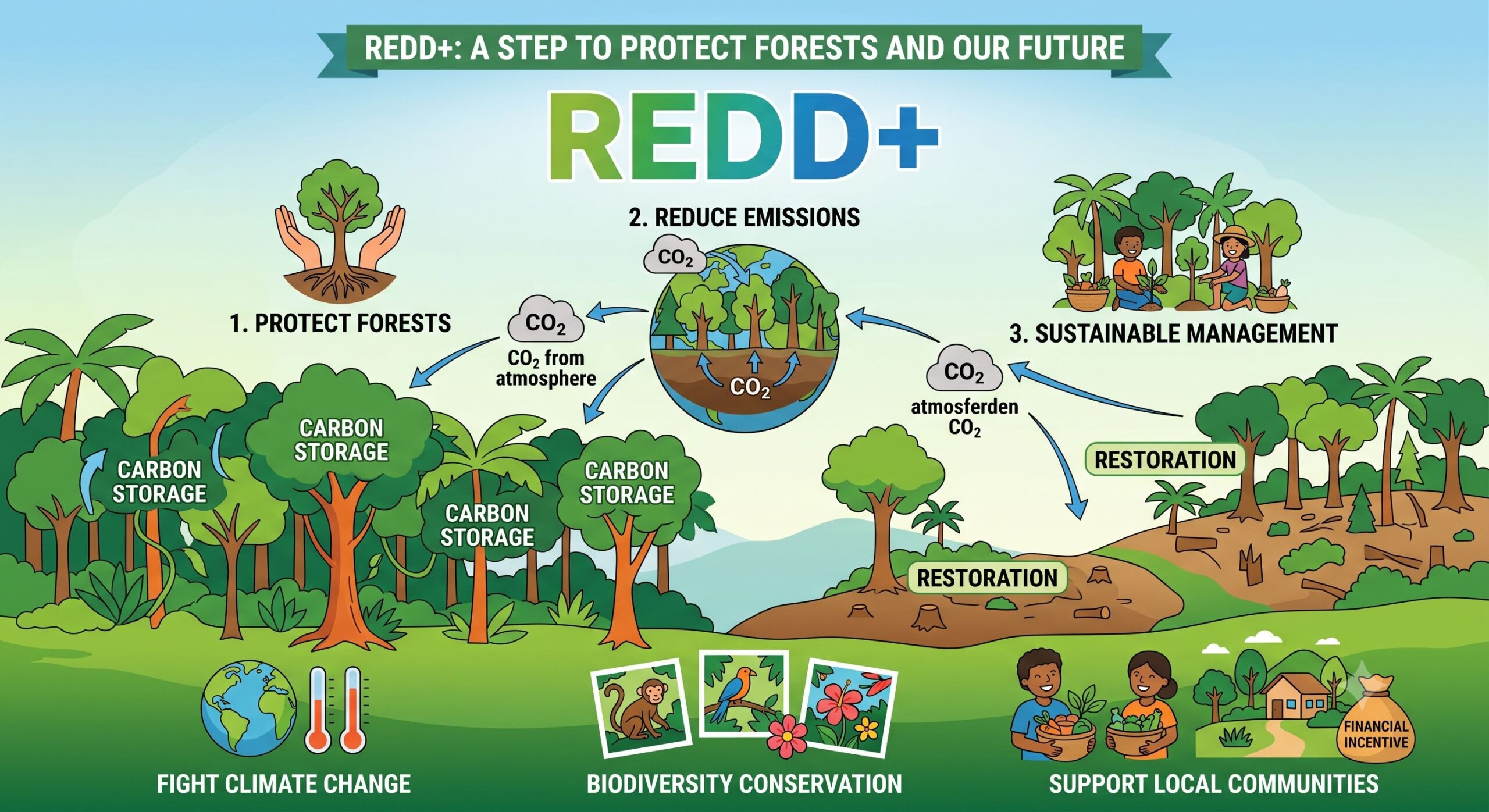
The framework itself enables countries to receive results-based payments for reducing emissions from deforestation and forest degradation (REDD), whilst the “plus” extends to conservation, sustainable forest management and the enhancement of forest carbon stocks (UNFCCC). REDD+ projects now cover 65 countries, reflecting a growing recognition that limiting climate change will be arduous at best without slowing deforestation (UN-REDD). At the same time, many forested countries face escalating pressures from commercial agriculture, infrastructure expansion, mining, energy demand and urbanisation, often without the financial resources required to respond. REDD+’s ubiquity is therefore not unfounded; it occupies an increasingly important position within the architecture of global climate governance, linking forest protection, international finance and national climate commitments.
Despite a normative focus on carbon emission reductions, forests are ecologically and politically complex territories, sustained through long-standing relationships between human and non-human life. Around 1.6 billion people depend on forests for some part of their livelihoods, including many Indigenous Peoples and Local Communities (IPLCs) (UN-DESA, 2021). These relationships may extend well beyond material dependence, encompassing customary law, ritual, identity, religion, spirituality and intergenerational obligation (Chan et al., 2012; Fish et al., 2016). Access to land and resources is often mediated through customary institutions and locally grounded forms of authority, meaning that forests are already inhabited, interpreted and governed before REDD+ enters them.
Despite these rich relationships, the history of forest governance has rarely been peaceful or just for IPLCs. Across many colonial contexts, forest departments converted customary territories into state-controlled forests, criminalised customary forms of use, and represented forest peoples as impediments to conservation, productivity and administrative control (see Gadgil & Guha, 1992; Anker, 2001). These practices constituted a broader colonial logic through which Indigenous territorial authority was displaced to secure control over land (Wolfe, 2006). Subsequently, REDD+ operates in ecosystems in which authority has long been contested and where the power of local communities to define and enact stewardship carries a violent inheritance.
Adopted in 2007, the United Nations Declaration on the Rights of Indigenous Peoples (UNDRIP) provides a prescriptive foundation for addressing these legacies. It affirms Indigenous Peoples’ rights to self-determination, customary lands, territories, and resources, and to participate through their own representative institutions. Articles 19 and 32 require states to consult and cooperate in good faith with Indigenous Peoples in order to obtain their Free, Prior and Informed Consent (FPIC) before adopting measures or approving projects that may affect their rights, lands or resources (UNDRIP, 2007). The UNDRIP has thus set a precedent for Indigenous Peoples as collective rights-holders with authority over decisions affecting their territories.
Against this background, recognitional justice concerns whether marginalised groups are respected in the cultural, political and institutional terms through which they understand themselves, their rights and their relationships to place (Schlosberg, 2007; Sultana, 2021). For IPLCs, sufficient recognition means being treated as rights-holders, knowledge-holders and political authorities over the territories REDD+ governs. Projects, therefore, may inherently harbour a politics of recognition, because every intervention advances an account of what forests are, why they are being lost, and who has the authority to protect them.
This article argues that REDD+ may produce injustice when it misrecognises the value of forests, forest inhabitants and forest governance. Three forms of misrecognition are especially acute. Firstly, forests may be rendered primarily through carbon metrics, weakening cultural, territorial and ecological values as forms of political knowledge. Secondly, IPLCs may be wrongly cast as the principal drivers of forest loss and thus the most governable actors, while commercial agriculture, extractive industries and wider commodity systems receive less attention. Finally, participation may also be recognised through consultation, safeguards and documentary compliance, while genuine authority over land, finance and project design remains external. Where these dynamics converge, REDD+ may reproduce neocolonial patterns of governance, in which forest protection is organised through external categories and institutions that constrain local authority (see: Gadgil & Guha, 1992; Grove, 1995). Its legitimacy therefore rests on a wider conception of integrity, one capable of recognising forests as living territories, IPLCs as collective rights-holders and political actors, and participation as substantive authority over the terms of protection.
Misrecognition of the “Carbonised Forest”
Measurement, Reporting and Verification (MRV) plays an integral technical role within REDD+, enabling projects to demonstrate emissions reductions against a Forest Reference Emission Level. In practice, this involves estimating a baseline of expected forest loss, monitoring subsequent changes through satellite imagery, forest inventories and carbon modelling, reporting the resulting emissions reductions, and subjecting those claims to verification before payments or carbon credits are issued (UNFCCC). However, the evidence it privileges is far from politically neutral.
This ‘singularisation’ serves a legitimate purpose. By conceptualising the forest around a dominant value, science and technology can produce evidence which can travel quickly across project boundaries, national reporting systems, carbon registries and financial markets (Turnhout & Lynch, 2025). Consequently, carbon acquires exceptional institutional mobility, circulating through audits, corporate disclosures, and payment structures with far greater ease than less commensurable forest values. Biodiversity, sacred obligations, customary practices, subsistence use, and intergenerational stewardship, which resist the same forms of standardisation, therefore rarely exert equivalent influence over a project’s baseline, payment structure, or definition of success. They may still appear within REDD+ as co-benefits, safeguards or contextual considerations, though usually without the authority to shape the central architecture of carbon finance. This is built into the system’s design, since the evidence most capable of travelling is also the evidence most capable of governing.
This hierarchy may inherently produce recognitional and epistemic injustice because relationships between people and land are translated into categories whose authority has already been determined elsewhere. Local knowledge is given little influence over how the forest itself is defined, which values protection should preserve, and which interventions are considered acceptable. The result is a potentially extractive form of inclusion in which local knowledge is used to improve the system while the system’s underlying terms remain externally set.
A more just REDD+ would allow rights-holders to shape what is monitored, how success is judged and which losses are recognised. Plural, locally defined measures of forest value would therefore need to sit alongside carbon metrics within the project’s core architecture. Without this shift, technically credible accounting may continue to rest on a politically impoverished account of the forest.
Diagnostic Misrecognition
REDD+ national planning documents frequently position IPLCs and small-scale local actors as central targets of implementation, even where the broader literature identifies commercial agriculture, cattle ranching, plantation expansion and commodity demand as the major drivers of deforestation (Skutsch & Turnhout, 2020). Local practices can contribute to forest loss, though their prominence within REDD+ reflects how readily they fit its administrative architecture. Activities such as fuelwood collection, grazing, charcoal production, shifting cultivation and small-scale farming occur within or near monitored forest areas, where they can be observed through patrols, surveys, or remote sensing and quickly associated with visible changes in canopy cover. This makes them easier to convert into behavioural targets, access restrictions and alternative livelihood programmes (Turnhout & Lynch, 2025). Concurrently, agribusiness, mining, and infrastructure development operate through longer chains of responsibility, often beyond project boundaries and closer to politically powerful institutions (ibid).
The Kasigau Corridor project in Kenya shows how this localised diagnosis can reinforce existing inequality. Its claim to avoided deforestation rested heavily on reducing slash-and-burn agriculture and charcoal production, making local cultivation and forest use central to the production of carbon value. REDD+ entered Taita Taveta after colonial land alienation, postcolonial elite capture and the concentration of former communal lands within private and corporate ranches. Carbon revenues followed this inherited tenure structure; ranch owners held contractual claims to one-third of project revenues, whilst surrounding communities received the residual share after project costs. Many poorer residents also faced restrictions on cultivation, hunting, charcoal production and firewood collection (Chomba et al., 2016). IPLCs were therefore recognised chiefly through the practices that REDD+ required them to change, whilst the historical conditions that had shaped their dependence on those practices exerted less influence over project design. Unfortunately, this dynamic has more recently continued in Cambodia (Human Rights Watch, 2024), The Democratic Republic of Congo (Koh et al., 2025), and Indonesia (Sanders et al., 2020).
Diagnostic misrecognition can produce an intervention that inherently regulates the most visible actors whilst leaving the extractive structures that make forest conversion profitable underexamined. A more credible diagnosis would situate local practices within the tenure regimes, commodity chains and state development choices that shape them, allocating responsibility at the scales through which forest loss is elicited.
Misrecognition of Sufficient Participation
Even where REDD+ recognises more plural forest values and develops a credible account of deforestation, the question remains over who possesses the authority to determine the response. As aforementioned, REDD+ has usually addressed this through safeguards, consultation meetings, benefit-sharing arrangements and grievance mechanisms. These measures can create meaningful opportunities for engagement, though they commonly position IPLCs as stakeholders, beneficiaries or consultees within programmes whose material objectives have been pre-established (Osborne et al., 2024). This framing can also obscure important political distinctions. Indigenous communities enter REDD+ with collective rights to self-determination and territorial governance, established in the UNDRIP. Absorbing these rights into generic categories of stakeholder participation can weaken the authority emphasised by those very rights and the relationships they govern.
The distinction between invited and claimed spaces is astute (Cornwall and Coelho, 2007). Invited spaces are convened by governments, donors, or project developers, who usually determine the agenda, the available forms of participation, and the decisions open to revision. Claimed spaces emerge through Indigenous organisations, community institutions and territorial movements whose legitimacy does not depend upon an invitation from REDD+. They allow IPLCs to articulate priorities through political structures they recognise as their own. REDD+ has frequently expanded the spaces it invites without transferring equivalent control over agenda-setting, finance, or territorial governance. Projects in Acre, Brazil, and Ucayali, Peru, for example, both established Indigenous Working Groups and were celebrated as pioneers of intercultural climate governance. These institutions created channels through which Indigenous representatives could influence implementation, yet their control over financial decisions remained limited, while land rights and territorial governance received insufficient attention (de Wit & Mourato, 2022).
The incomplete translation of political authority into stakeholder input entails another recognitional failure. Communities may be consulted extensively and represented within formal institutions, but they exercise little control over the decisions that govern their territories. This distinction is critically important in forest landscapes shaped by colonial dispossession, the criminalisation of customary use and the displacement of Indigenous institutions by state-defined authority. Where REDD+ confines rights-holders to advisory roles within structures designed elsewhere, it can preserve the historical relations of power beneath the language of participation. A recognition-based REDD+ would therefore establish territorial rights, legitimate representative institutions and the decisions requiring consent before its financial and administrative architecture is settled. Carbon finance could then support priorities defined with rights-holders, allowing participation to express political authority rather than certify an externally designed process.
Conclusion
Despite its fundamental issues, REDD+ retains an important place within climate governance. Tropical forest protection requires sustained finance, and evidence suggests that well-targeted interventions can materially reduce deforestation and forest degradation, particularly in areas facing greater pressure (Guizar Coutiño et al., 2022). REDD+ has also helped keep deforestation visible in international negotiations and supported the development of national strategies, forest reference levels, safeguard systems, and monitoring capacity. These achievements should not be dismissed, but they cannot define integrity on their own.
This article has examined three ways in which the political integrity of REDD+ can be compromised through the politics of recognition. Firstly, carbon accounting can marginalise the intangible cultural and ecological understandings of forests. Secondly, interventions can place responsibility on forest communities, whose activities are easier to monitor than the commercial and political structures driving forest loss. Finally, consultation and representation can leave underlying authority over land, finance and project design largely unchanged. Together, these failures allow a technically effective intervention to reproduce the inequalities inherited from the histories of forest governance.
As COP31 approaches, with its growing emphasis on accelerating implementation, REDD+ should be judged on the political conditions through which environmental results are achieved. It must do more to address the commodity chains, tenure regimes, and state policies driving deforestation, and give IPLCs more authority over how their territories are valued, financed, and governed. Carbon accounting cannot redeem a system which reproduces dispossession through new environmental language; without political recognition, forest protection risks becoming another chapter in the history it claims to repair.
References
Anker, P. (2001). Imperial ecology: Environmental order in the British Empire, 1895–1945. Harvard University Press.
Chan, K. M. A., Satterfield, T., & Goldstein, J. (2012). Rethinking ecosystem services to better address and navigate cultural values. Ecological Economics, 74, 8–18. https://doi.org/10.1016/j.ecolecon.2011.11.011
Chomba, S., Kariuki, J., Lund, J. F., & Sinclair, F. (2016). Roots of inequity: How the implementation of REDD+ reinforces past injustices. Land Use Policy, 50, 202–213. https://doi.org/10.1016/j.landusepol.2015.09.021
Cornwall, A., & Coelho, V. S. P. (2007). Spaces for change? The politics of participation in new democratic arenas. In A. Cornwall & V. S. P. Coelho (Eds.), Spaces for change? The politics of citizen participation in new democratic arenas (pp. 1–29). Zed Books
de Wit, F., & Mourato, J. (2022). Governing the diverse forest: Polycentric climate governance in the Amazon. World Development, 157, 105955. https://doi.org/10.1016/j.worlddev.2022.105955
Fish, R., Church, A., & Winter, M. (2016). Conceptualising cultural ecosystem services: A novel framework for research and critical engagement. Ecosystem Services, 21, 208– 217. https://doi.org/10.1016/j.ecoser.2016.09.002
Gadgil, M., & Guha, R. (1992). This fissured land: An ecological history of India. Oxford University Press.
Grove, R. H. (1995). Green imperialism: Colonial expansion, tropical island Edens and the origins of environmentalism, 1600–1860. Cambridge University Press.
Guizar-Coutiño, A., Jones, J. P. G., Balmford, A., Carmenta, R., & Coomes, D. A. (2022). A global evaluation of the effectiveness of voluntary REDD+ projects at reducing deforestation and degradation in the moist tropics. Conservation Biology, 36(6), e13970. https://doi.org/10.1111/cobi.13970
Human Rights Watch. (2024). Carbon offsetting’s casualties: Violations of Chong Indigenous people’s rights in Cambodia’s Southern Cardamom REDD+ Project.
Koh, N. S., Pietarinen, N., Ville, A., Kengoum, F., Wong, G., & Brockhaus, M. (2025). Follow the money: Can REDD+ finance compete with established and emerging land investments in Mai-Ndombe, Democratic Republic of Congo? Forest Policy and Economics, 181, 103664. https://doi.org/10.1016/j.forpol.2025.103664
Osborne, T., Cifuentes, S., Dev, L., Howard, S., Marchi, E., Withey, L., & Rocha da Silva, M. S. (2024). Climate justice, forests, and Indigenous Peoples: Toward an alternative to REDD+ for the Amazon. Climatic Change, 177, Article 128. https://doi.org/10.1007/s10584-024-03774-7
Sanders, A. J. P., Ford, R. M., Keenan, R. J., & Larson, A. M. (2020). Learning through practice? Learning from the REDD+ demonstration project, Kalimantan Forests and Climate Partnership (KFCP) in Indonesia. Land Use Policy, 91, 104285. https://doi.org/10.1016/j.landusepol.2019.104285
Schlosberg, D. (2007.). 1 1 Defining Environmental Justice
Skutsch, M., & Turnhout, E. (2020). REDD+: If communities are the solution, what is the problem? World Development, 130, 104942. https://doi.org/10.1016/j.worlddev.2020.104942
Sultana, F. (2021). Critical climate justice.
Turnhout, E., & Lynch, C. R. (2025). Raising the carbonized forest: Science and technologies of singularization. Environment and Planning F, 4(2), 111–123. https://doi.org/10.1177/26349825241255685
UN-REDD Programme. (n.d.). About the programme. Retrieved July 15, 2026, from https://www.un-redd.org/about/un-redd-programm
United Nations Framework Convention on Climate Change. (2016). The Paris Agreement (FCCC/CP/2015/10/Add.1). United Nations.
United Nations Framework Convention on Climate Change. (n.d.). What is REDD+? Retrieved July 15, 2026, from https://unfccc.int/topics/land-use/workstreams/redd/what-is-redd
United Nations General Assembly. (2007). United Nations Declaration on the Rights of Indigenous Peoples(A/RES/61/295). United Nations.
Wolfe, P. (2006). Settler colonialism and the elimination of the native. Journal of Genocide Research, 8(4), 387–409. https://doi.org/10.1080/14623520601056240