

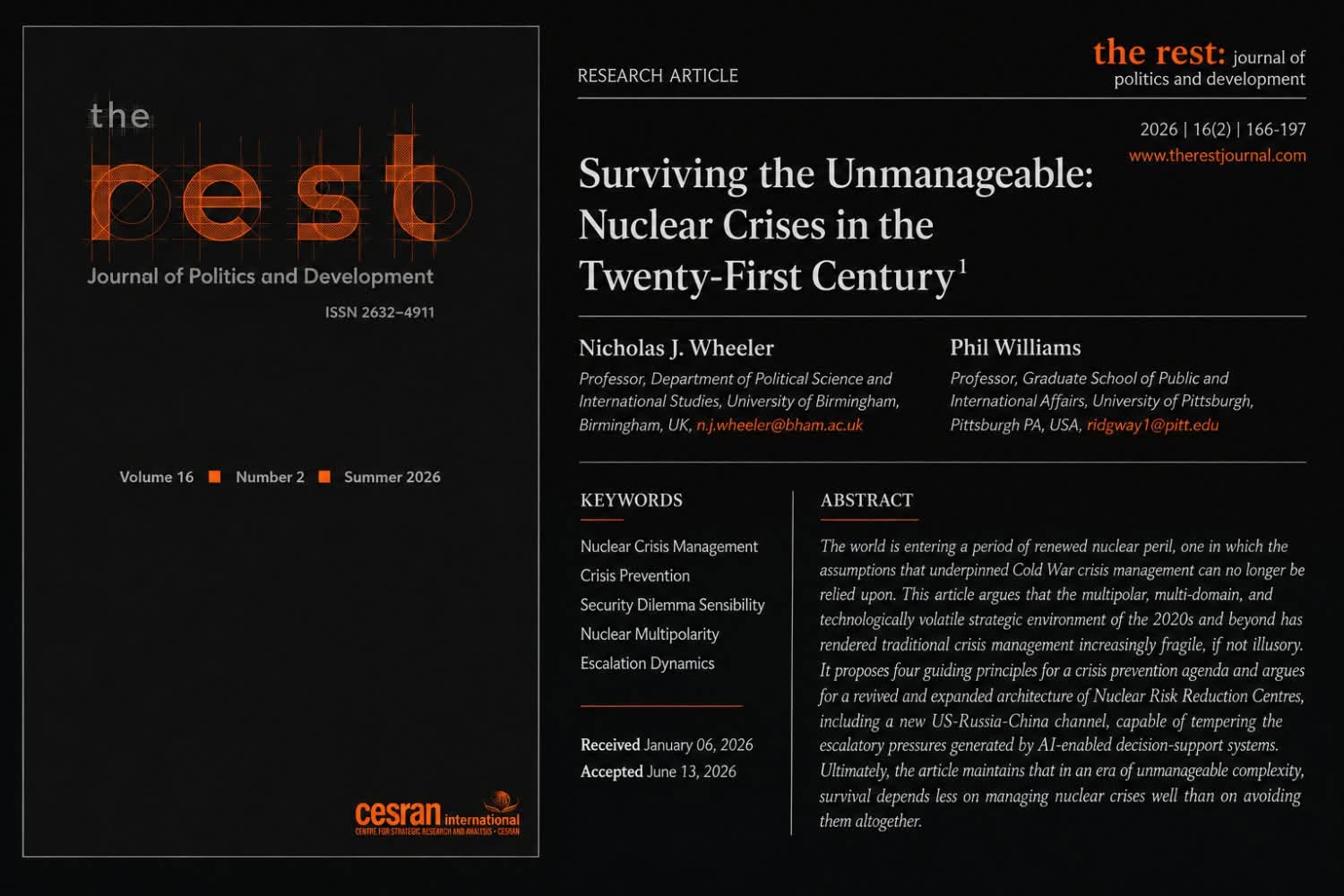
Nicholas J. Wheeler
Professor, Department of Political Science and International Studies, University of Birmingham, Birmingham, UK, [email protected]
Phil Williams
Professor, Graduate School of Public and International Affairs, University of Pittsburgh, Pittsburgh PA, USA, [email protected]
 The world is entering a period of renewed nuclear peril, one in which the assumptions that underpinned Cold War crisis management can no longer be relied upon. This article argues that the multipolar, multi-domain, and technologically volatile strategic environment of the 2020s and beyond has rendered traditional crisis management increasingly fragile, if not illusory. Building on Richard Ned Lebow’s early warning that crisis management was “a dangerous illusion,” the article contends that contemporary dynamics—nuclear multipolarity, the entanglement of conventional and nuclear capabilities, the development of warfighting rather than purely deterrent weapons, the disruptive potential of artificial intelligence and quantum computing, and the corrosive effects of information overload and deep fakes—have combined to create a strategic context far more dangerous and unpredictable than that of the Cold War. Re-engaging with Cold War history, the article shows that empathy, restraint, and clear communication helped keep crises from tipping into nuclear war but argues that these conditions cannot simply be transplanted into a far more complex and ambiguous present. Because crisis management in this new era is likely to be both fragile and perilous, the article contends that the analytical and policy focus must shift decisively from managing crises towards preventing them. It proposes four guiding principles for a crisis prevention agenda: never cornering a nuclear-armed adversary; strengthening confidence in mutual nuclear restraint; cultivating and embedding Security Dilemma Sensibility before crises emerge; and treating communication as a vehicle for reassurance rather than coercive leverage. The article further argues for a revived and expanded architecture of Nuclear Risk Reduction Centres, including a new US-Russia-China channel, capable of tempering the escalatory pressures generated by AI-enabled decision-support systems. Ultimately, the article maintains that in an era of unmanageable complexity, survival depends less on managing nuclear crises well than on avoiding them altogether.
Keywords: Nuclear Crisis Management, Crisis Prevention, Security Dilemma Sensibility, Nuclear Multipolarity, Escalation Dynamics