


By Alexandra Judge, Research Fellow
Across the world, states are reaching beyond their borders to monitor, intimidate, and repress dissent. From diaspora activists facing digital harassment to dissident journalists surveilled abroad, transnational repression has become a defining feature of contemporary global politics. Yet these practices are not limited to autocratic regimes. Liberal democracies are increasingly adopting similar tools through legal, discursive, and institutional means that reframe dissent as extremism.
In the United Kingdom, the 2025 proscription of Palestine Action (PA) – a direct-action network targeting British arms companies linked to Israel – marks a significant moment in the shrinking space for protest. Drawing on my MA research at Lancaster University, this article explores how the UK’s counterterrorism and foreign policy frameworks intersect to transform domestic activism into a security threat. The case of PA offers a window into the subtler, bureaucratised forms of transnational repression now emerging within liberal democracies.
Freedom House’s long-term monitoring project has documented a steady rise in state-led repression targeting activists abroad. Between 2014 and 2022, at least 854 direct, physical incidents of transnational repression, including assassination, abduction, detention, and unlawful deportation, were recorded across 91 host countries, committed by 38 governments (Freedom House, 2023). By 2023, this figure had grown to 1,034 incidents involving 44 governments and 100 host countries (Freedom House 2023b).
While such repression is most visible in autocracies such as China’s policing of Uyghurs in exile, Russia’s intimidation of dissidents, and Iran’s targeting of women’s rights campaigners, liberal democracies often enable it indirectly. Counterterrorism cooperation, surveillance partnerships, and restrictive protest laws form an infrastructure that blurs the line between national and transnational control.
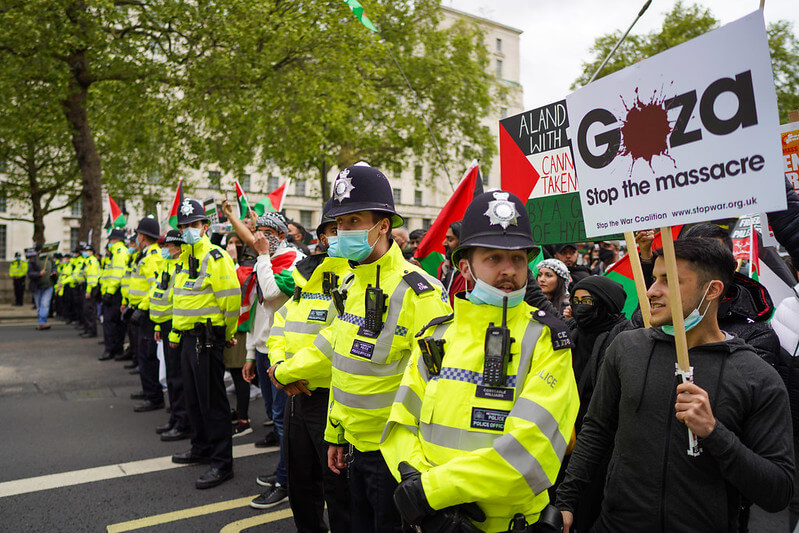
As Aradau (2004) observes, securitisation transforms political disputes into questions of order and threat, allowing governments to sidestep democratic deliberation. This dynamic is increasingly evident in the policing of Palestine solidarity activism. From France’s temporary bans on Gaza demonstrations to U.S. campus arrests, protest is being recast as disorder. The UK’s proscription of Palestine Action extends this logic by legally defining protest as terrorism, merging domestic order with foreign policy alignment.
Founded in 2020, Palestine Action employed non-lethal direct-action tactics, including occupations, spray-painting, and symbolic property damage, to protest the UK’s arms trade with Israel. Following Hamas’ 7 October 2023 attack and Israel’s subsequent bombardment of Gaza, the political climate shifted dramatically. Government ministers began describing pro-Palestine demonstrations as “hate marches” and “mobs,” language that blurred the line between protest and extremism. The Public Order Act 2023 introduced new offences such as “locking-on” and “serious-disruption prevention orders,” empowering pre-emptive policing and surveillance. By mid-2025, after an action at RAF Brize Norton in which activists spray-painted two aircraft, the Home Office claimed PA posed a threat to “national security.” On 23 June 2025, Home Secretary Yvette Cooper formally proscribed Palestine Action under Section 3 of the Terrorism Act 2000, making it illegal to support or belong to the organisation (Hansard, 2025).
As I argue in ‘Constructing the Threat: Palestine Action and the Shrinking Space for Protest’ (Judge, 2025), this decision exemplifies the process of securitisation outlined by Buzan, Wæver and de Wilde (1998): political actors construct issues as security threats through authoritative speech acts, institutional mechanisms, and public silence. Audience acceptance was secured not through mass panic but through passive legitimation via public fatigue with protest, political inertia, and media narratives of order and threat (Roe, 2008). The result is unprecedented: the extension of the “terrorist” label to a non-violent protest movement.
Although PA’s proscription is formally domestic, it cannot be divorced from Britain’s foreign-policy alignment with Israel. The UK remains a key supplier of components used in Israeli weapons systems and a consistent diplomatic supporter of Israel at the UN. By criminalising a movement that targeted this relationship, the British government effectively securitised its foreign policy through domestic law. This is a subtle form of transnational repression in which dissent within the UK is curtailed in the service of another state’s strategic interests. These dynamics are reinforced by global counterterrorism frameworks and intelligence-sharing arrangements such as the Five Eyes alliance. As Bigo (2008) argues, contemporary security governance functions as a ban-opticon: a transnational field of surveillance and control that classifies populations by perceived risk rather than concrete actions.
Through this lens, the UK’s repression of Palestine solidarity activism becomes part of a transnational network of securitisation, where activism critical of allied states is reframed as extremism. The repression is diffuse and bureaucratic, exercised through law, discourse, and alignment rather than overt coercion. The proscription of Palestine Action reflects a wider democratic contraction in the UK. The cumulative effects of the Public Order Act (2023) and the Nationality and Borders Act (2022) have subordinated protest rights to the imperatives of “security” and “order.”
As Aradau (2004) and Huysmans (2006) argue, liberal democracies maintain legitimacy not by avoiding repression but by legalising it. Parliamentary debate on PA’s designation was minimal; only a handful of MPs raised civil-liberties concerns. This silence illustrates passive audience acceptance where exceptional measures are normalised through the absence of resistance (Roe 2008).
The racialised framing of Palestinian activism compounds this process. Political and media narratives often conflate pro-Palestine protest with extremism or anti-Semitism, producing what Pantazis and Pemberton (2009) term a “suspect community.” Such framing erases the political content of activism, legitimising surveillance and suppression under the banner of public safety.
Transnational repression in liberal democracies operates not through violence but through administrative normality including legal orders, designations, and discourse. The securitisation of dissent in the UK illustrates how counterterrorism logic has expanded to encompass political activism. If democracies continue to frame protest as extremism, they risk internalising the illiberal practices they claim to oppose. Defending democratic participation therefore requires not just legal reform but a deeper challenge to the security paradigms underpinning governance.
Academic research, investigative journalism, and civil-society activism must together expose and resist this normalisation of exception. As the Palestine Action case shows, the erosion of protest rights rarely happens through crisis. It happens gradually, as the extraordinary becomes ordinary.
References
Aradau, C. (2004) ‘Security and the Democratic Scene’, Journal of International Studies, 32(4).
Balzacq, T. (2005) ‘The Three Faces of Securitisation’, European Journal of International Relations, 11(2).
Bigo, D. (2008) ‘Security: A Field Left Fallow’, in Security and Migration in the EU.
Buzan, B., Wæver, O. & de Wilde, J. (1998) Security: A New Framework for Analysis. Lynne Rienner.
Freedom House (2023) Still Not Safe: Transnational Repression in 2022. Washington, DC: Freedom House. Available at: https://freedomhouse.org/sites/default/files/2023-04/FH_TransnationalRepression2023_0.pdf
Freedom House (2023b) Transnational Repression 2023: Insecure Leaders Threaten Dissent Abroad. Available at: https://freedomhouse.org/article/transnational-repression-2023-insecure-leaders-threaten-dissent-abroad
Hansard (2025) Palestine Action (Proscription). 23 June 2025. Available at: https://hansard.parliament.uk/commons/2025-06-23/debates/25062337000014/PalestineActionProscription
Huysmans, J. (2006) The Politics of Insecurity: Fear, Migration and Asylum in the EU. Routledge.
Judge, A. (2025) Constructing the Threat: Palestine Action and the Shrinking Space for Protest. Unpublished MA dissertation, Lancaster University.
Pantazis, C. & Pemberton, S. (2009) ‘From the “Old” to the “New” Suspect Community’, British Journal of Criminology, 49(5).
Roe, P. (2008) ‘Actor, Audience and Emergency Measures’, Security Dialogue, 39(6).
Selmini, R. & Di Ronco, A. (2023) ‘Criminalising Dissent in Europe’, Crime, Law and Social Change, 80(5).