

Anastasiia Prokopenko
CESRAN International Review Editor
The political landscape across Europe and the UK is undergoing a profound transformation, driven significantly by the contentious issues of migration, asylum, and deportation. With a series of party elections in 2024 and 2025, and the enduring influence of Brexit, anti-migration and far-right parties have seen a surge in popularity, compelling mainstream political blocs to adopt more restrictive and securitised immigration policies. This shift signals a major turning point, moving away from past norms toward a system focused heavily on externalisation and deterrence.
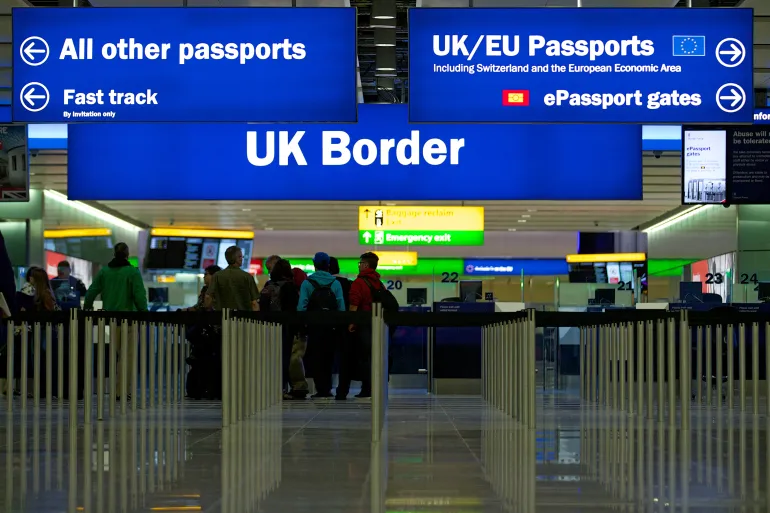
In the UK, post-Brexit sovereignty has been leveraged to pursue increasingly tougher measures, aiming to “restore control” over the immigration system. One of the most visible developments is the UK-France ‘one-in, one-out’ pilot deal. This agreement is designed to counter the record number of small boat arrivals across the Channel, allowing the UK to return a pre-determined number of irregular migrants to France in exchange for legally accepting an equal number of vetted asylum seekers who have strong ties to the UK. While framed as a deterrent and a safe legal route, critics point out the system’s limited capacity—with an initial cap on returns—raising serious questions about the UK’s obligations under international law, particularly the principle of non-refoulement.
Simultaneously, the European Union has adopted the ambitious and controversial Pact on Migration and Asylum. Set to take effect fully from June 2026, the Pact introduces a more coordinated, yet significantly more restrictive, common framework for managing migration across the 27 member states. Key to this “innovative solution” is the creation of a mandatory border procedure for asylum applicants deemed unlikely to qualify for protection, security risks, or those who mislead authorities. These individuals will be processed in designated border facilities with legally binding timeframes.
Crucially, the Pact introduces a permanent solidarity mechanism, compelling member states to either accept a share of relocated asylum seekers or provide financial contributions and operational support. However, the most debated element is the intensified focus on externalisation of asylum procedures and the creation of “return hubs” in third countries, designed to strengthen partnerships with non-EU nations to prevent irregular departures and ensure cooperation on readmission. The tough stance adopted by the UK and EU appears to be yielding a quantitative shift in migration flows, reflecting the success of deterrence strategies in the short term. The figures for 2025 demonstrate a measurable decrease in pressure on EU borders:
- Frontex, the European Border and Coast Guard Agency, reported on September 12 that irregular entries dropped by 21% in the first eight months of 2025, down to 112,375 detections. Steepest declines were recorded on the Western Balkan (–47%), Eastern land border (–44%), and Western African routes (–52%).
- In parallel, the European Union Agency for Asylum (EUAA) reported that asylum applications fell by 23% in the first half of 2025, totalling 399,000. This decrease was largely driven by a two-thirds fall in Syrian applications, a major change in historical trends.
However, these domestic successes are tempered by the escalating risks for those still attempting the journey. The International Organisation for Migration (IOM) estimated that 1,131 people have died attempting to cross the Mediterranean so far this year. This enduring human cost highlights that while irregular entries and asylum claims within the EU may be falling, the migration problem has not disappeared—it has become deadlier.
As the political pressure from far-right and anti-migration parties continues to grow across the continent, particularly in the lead-up to key elections, mainstream governments have been forced to double down on these restrictive policies. The debate has dramatically shifted from how to integrate to how to deter and how to deport. The legislative frameworks now being erected in the UK and the EU are a direct response to this political environment, yet their long-term effectiveness in solving the underlying drivers of migration, while maintaining social cohesion and upholding humanitarian standards, remains a deeply divisive and uncertain prospect.
Bibliography
ETIAS. (2025). EU Migration Trends Shift in 2025: Asylum Claims Down, Border Crossings Fall. [online] Available at: https://etias.com/articles/eu-migration-trends-shift-in-2025-asylum-claims-down,-border-crossings-fall.
Europa.eu. (2025). EU external borders: irregular crossings down 18% in the first 7 months of 2025. [online] Available at: https://www.frontex.europa.eu/media-centre/news/news-release/eu-external-borders-irregular-crossings-down-18-in-the-first-7-months-of-2025-ArNz2R.
Gill, J. (2025). Fortress Europe: What will migration policy look like in 2025? [online] Context.news. Available at: https://www.context.news/socioeconomic-inclusion/fortress-europe-what-will-migration-policy-look-like-in-2025.
Ten migration issues to look out for in 2025: Origins, key events and priorities for Europe ICMPD Migration Outlook 2025. (2025). Available at: https://www.icmpd.org/file/download/63373/file/ICMPD%2520Migration%2520Outlook%25202025.pdf.
The Migration Observatory (2025). Net migration to the UK – Migration Observatory. [online] Migration Observatory. Available at: https://migrationobservatory.ox.ac.uk/resources/briefings/long-term-international-migration-flows-to-and-from-the-uk/.