

Bulent Gokay *
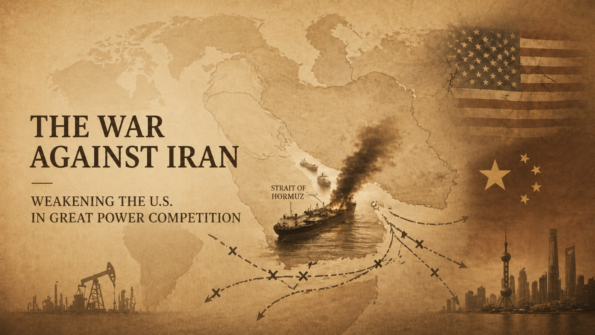
Trump’s recent visit to Beijing and the meetings with Xi took place amid heightened geopolitical insecurity in the Gulf and economic chaos elsewhere, both of which are the results of America’s ill-thought-out war against Iran. The Trump-Xi meeting has also clearly demonstrated that decoupling between the two superpowers is unrealistic. The economies of the US and China are so closely intertwined that separation is impossible. The US and China are locked in a highly asymmetric yet mutually binding relationship, and those claiming otherwise are wasting time and energy. The US cannot rapidly cease reliance on Chinese rare earth metals; its R&D heavily depends on them. Additionally, over a third of American pharmaceutical ingredients are sourced from China. Similarly, Chinese industries face comparable supply-chain vulnerabilities in technology and agriculture, depending heavily on the U.S. for advanced AI hardware and essential feed inputs such as soybeans and amino acids. Therefore, interdependence exists in both directions (Noland, 2026).
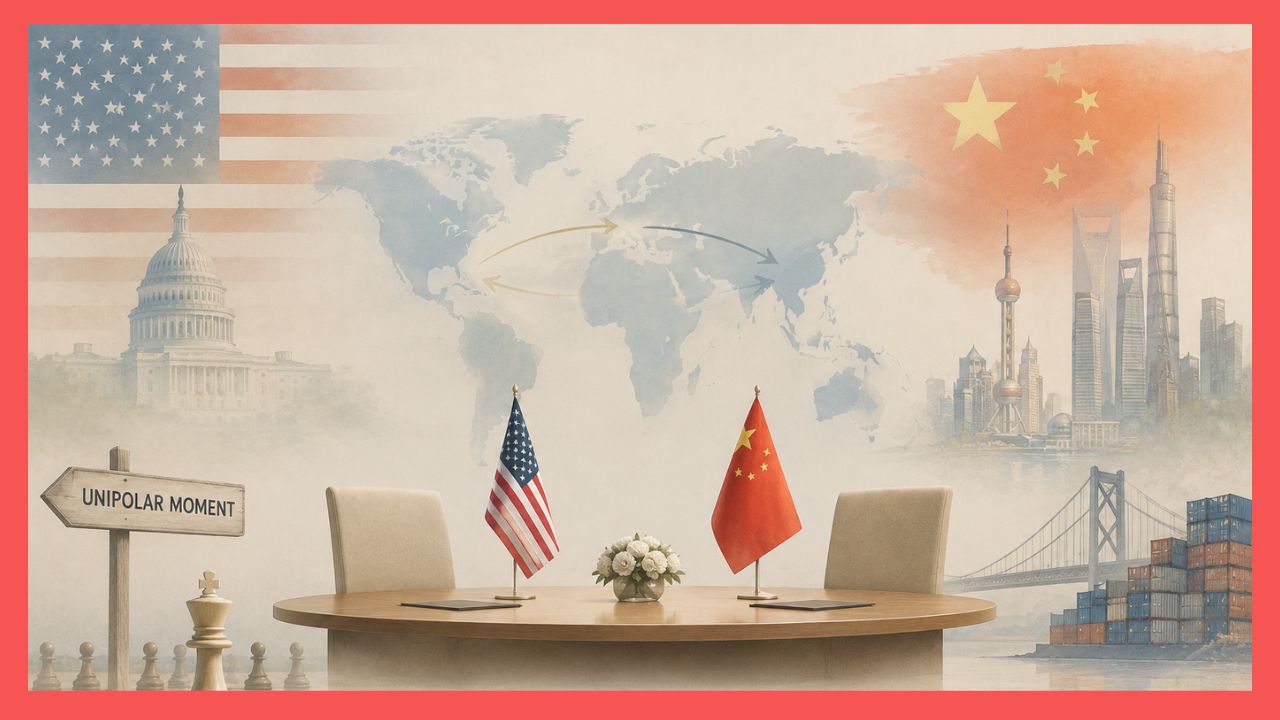
Apart from showing how interdependent the world’s two superpowers have become, the Trump-Xi summit has also clearly shown how far the global architecture of power has changed since the early days of the post-Cold War era, the last decade of the 20th century. The end of the Cold War ushered in the “Unipolar Moment,” a period where the United States emerged as the sole global superpower. Flush with triumph, Washington largely operated on the assumption that its liberal-democratic model would go unchallenged, paving the way for unprecedented American hegemony.
In the summer of 1989, the National Interest featured an essay with the provocative title “The End of History?” by Francis Fukuyama (Summer 1989: 3-18). In this highly optimistic article, Fukuyama argued that, following the dissolution of the Soviet bloc in Eastern Europe, humanity’s ideological evolution was complete, claiming that the state-socialist system had failed and that Western liberal democracy had triumphed, ushering in a post-ideological world. He further argued that Western liberal democracy, characterised by a refined balance of liberty and equality, is unparalleled; that achieving it would result in a widespread soothing of global issues; and that ultimately, it would emerge as the only viable option. “What we are witnessing”, he wrote, “is not just the end of the cold war, or a passing of a particular period of post-war history, but the end of history as such: that is, the end point of mankind’s ideological evolution and the universalisation of western liberal democracy as the final form of human government”. Three years after the essay’s publication, Fukuyama expanded his 18-page article into the book The End of History and the Last Man (Fukuyama, 1992).
What Fukuyama was talking about in The End of History and the Last Man was shared not only by Neoconservatives but also by Democrats, and in a way, this was the shared opinion and belief of the US economic and political elite at the beginning of the twenty-first century. Interestingly, there was little difference between the foreign policy perspectives of key Republicans and Democrats. Both groups believed in their moral and intellectual superiority and viewed foreign policy as a moral struggle between good and evil. To maintain America’s global dominance and oppose potential challenges, both parties supported a series of wars and foreign interventions.
Probably, one of the clearest expressions of this position was summarised by Thomas Friedman, Madeleine Albright’s advisor:
The hidden hand of the market will never work without a hidden fist — McDonald’s cannot flourish without McDonnell Douglas, the builder of the F-15. And the hidden fist that keeps the world safe for Silicon Valley’s technologies is called the United States Army, Air Force, Navy and Marine Corps. … America truly is the ultimate benign superpower and reluctant enforcer (Friedman, 1999)
This statement, shared and expressed by many on both sides of US political life in the post-Cold War era, has since become a symbol of American arrogance and idealism bordering on determinism and self-importance in international affairs. From Bill Clinton’s strategy of “engagement” to George W. Bush’s “freedom agenda”, the US ruling elites, who have largely controlled the international system since 1991, have interpreted US interests so broadly as to become almost meaningless (Bush, 2002).
America’s unipolar moment did not vanish suddenly. The shift towards a more competitive, multipolar, or bipolar global order was accelerated by a combination of factors, including China’s economic rise, Russia’s recovery, costly U.S. foreign entanglements, and broader systemic shifts in the international system. The prolonged, resource-heavy conflicts after the “War on Terror,” including the wars in Afghanistan and Iraq, consumed significant American blood and resources, constraining Washington’s capacity to influence global events unilaterally. China’s swift rise as an economic, technological, and military force has made it a “near-peer” rival, capable of challenging American dominance worldwide. Consequently, instead of a seamless shift back to Cold War-era bipolarity, the global system has become a highly intricate and interconnected landscape. Within this complex multipolar system, the rise of China is widely considered by experts to be the primary driver behind the end of America’s unipolar moment, ushering in a new era of great-power competition.
The recent Xi-Trump meeting in China can be seen as unmistakable evidence of this emerging architecture of power. The meeting has enhanced China’s image as a confident and steady global power, distinctly different from Trump’s America, which appears distracted, unstable, impulsive, fragile, and panicked, acting with “hegemonic anxiety”. Ultimately, while several experts and think tanks noted that the summit succeeded in temporarily stabilising a highly volatile relationship, it also reinforced the widely held belief that Washington is an anxious hegemon in steady decline (Yoeli, 2026).
- Bulent Gokay is a professor of International Relations at Keele University.
References
Bush, George W. (2002). “Prevent Our Enemies from Threatening Us, Our Allies, and Our Friends with Weapons of Mass Destruction”, The White House, 1 June, https://georgewbush-whitehouse.archives.gov/nsc/nss/2002/nss5.html
Friedman, Thomas L. (1999). “A Manifesto for the Fast World”, The New York Times Magazine, 28 March, https://www.nytimes.com/1999/03/28/magazine/a-manifesto-for-the-fast-world.html
Fukuyama, Francis (1989). “The End of History?” National Interest, No. 16, Summer, https://www.jstor.org/stable/24027184
Fukuyama, Francis (1992). The End of History and the Last Man, Free Press.
Noland, Marcus (2026). “US-China cooperative interdependence: Opportunities and obstacles”, Peterson Institute, April, US-China cooperative interdependence: Opportunities and obstacles | PIIE
Yoeli, Max (2026). “Trump–Xi summit will be about managing US–China rivalry, not resolving it”, Chatham House, 13 May, Trump–Xi summit will be about managing US–China rivalry, not resolving it | Chatham House – International Affairs Think Tank