

by Sardar Aziz*
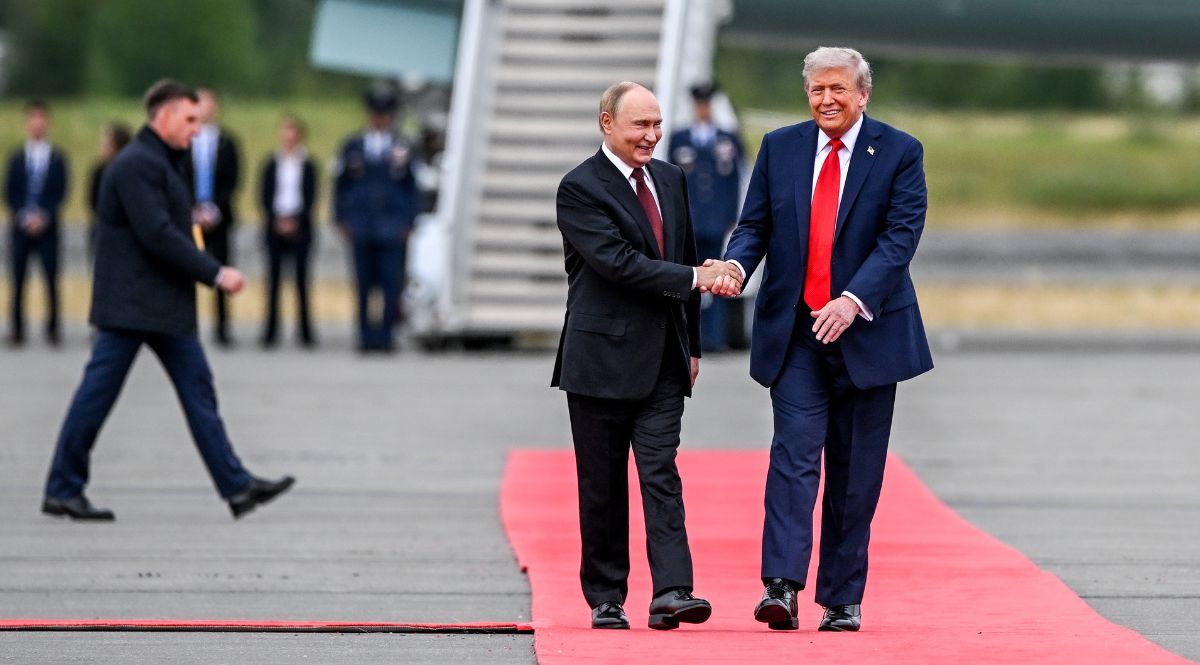
The U.S. president, Donald Trump, and the Russian president, Vladimir Putin, met in Alaska in a most spectacular way. The meeting had different meanings for different people around the world. Trump met Putin in very different circumstances than any previous U.S. president. Watching the meeting from a Middle Eastern perspective was intriguing this time.
The relationships between both presidents and Middle Eastern countries are complex. Both American and Russian presidents now have more in common with Middle Eastern leaders in terms of style and taste for power than any previous presidents before them in recent times. The Middle East political environment was accustomed to the domination of personalities, ego, display of force, noticeable lack of democracy, and entertaining autocracy.
Before everything else, Trump organised the summit to bring about peace and establish, or at least show himself as a peacemaker. It was therefore not shocking when it failed to accomplish any specific, tangible objective. This particular aspect resembled the Middle Eastern style of meeting, as it is commonly said, the leaders in the Middle East agreed to disagree.
However, given the increasing amount of information that is becoming available, the summit was significant in many ways. Even if Ukraine was undoubtedly the focus of immediate attention, the meeting will have a significant influence on the Middle East and the wider region. Especially as Russia and the United States have a complex and long relationship with the Middle East, and their behaviour will be imitated in the region.
As the U.S. is changing and focusing more on China, the Middle Eastern elites viewed Russia as an option, as they feared the U.S.’s relative withdrawal from the area. In contrast to the U.S., especially the Democratic leaders, who were viewed as unpredictable and untrustworthy, especially when Obama turned on the Egyptian leader Mubarak, Russia and its leader were viewed as appealing since they were demonstrating stability in support of their clients in the region.
Russia’s closeness to the Axis of Resistance was viewed as strategically significant by the latter. Despite this, Russia maintained positive relations with Israel, the Gulf states, and Turkey. All of this changed, though, when Putin was unable to save Bashar al-Assad, the former president of Syria. As a result, the notion that Putin would not desert his allies changed significantly, and Russia’s vulnerability was made even more obvious, particularly in the wake of the U.S. and Israeli war on Iran and the deal in Central Asia.
During the Alaska meeting, there was a hint of the Trump attack on Iran when the B-2 stealth bomber sliced through the skies, and both leaders noticed it clearly. It was a show of power from Trump, and it could be read as an insult to Putin. But Putin had other important things on his agenda that morning, rather than just a self-indulgent show.
If the meeting was Middle Eastern in its manifestation, it was also a moment that should shake the Middle Eastern elites and people. Now, it is obvious that neither Russia nor America is a reliable power. If democracy contributed to the U.S.’s unreliability in the past, now, factors of domestic polarisation, withdrawing from the world, and abandoning democracy are all contributing to the U.S.’s unreliability.
Although the Russian story might be different, being incapable of winning and sinking in the Ukraine quagmire made Russia abandon its allies in the Middle East and Central Asia and prioritise its other strategic issues, like the Black Sea, for instance. When it comes to the Middle East, both Russia and the U.S. are taking a similar path, albeit for different reasons; namely, both are changing their relationship with the Middle East.
New Beginning for Russia: “Good afternoon, dear neighbour.”
One issue that became apparent in the Alaska meeting was Russia’s interest in having economic deals with the U.S., as Putin put it, becoming a ‘dear neighbour.’ This is conceivable from the U.S. side, not only because of Trump and MAGA’s favourable view toward Russia but also because the limited Russian military capability in Ukraine showed that Russia is no longer a U.S. rival.
Hence, there is a possibility of a new beginning for Russia. If we manage to shift the focus to Putin and concentrate more on Russia, we might be able to better decipher the impact on the Middle East. When Russia aimed to be a global power, it had to do two things, among others: first, compete with the U.S.; and second, primarily in the Middle East. During the former Soviet era, Russia had influence in the region. The CCCP letters on Lavrov’s shirt were longing for that long-gone era. The Ukraine war has buried the imperial dream of Russia; however, abandoning empire is never easy, mainly as Putin is a historically minded person.
In the post-Soviet era, Russia hoped to be accepted as a big power like others, especially by the West. That was not materialised. As a response, the Primakov doctrine emerged. It posits that a unipolar world dominated by the United States is unacceptable to Russia. Therefore, Russia should strive toward a multipolar world managed by a concert of major powers that can counterbalance U.S. unilateral power. Russia should insist on its primacy in the post-Soviet space and lead integration in that region, and Russia should oppose NATO expansion. The doctrine was implemented recklessly in many places. The Alaska meeting was an event that marked the end of this doctrine.
As Dmitri Trenin put it, “the suspicion that Moscow is busy restoring the Soviet Union under a different name is baseless; in fact, Russia is busy establishing itself as the principal and most consequential power along its new borders”.
The Russian war on Ukraine has ended the ability of Russia to compete with the U.S., to be involved in more than one war at the same time, and to defend its allies. These are the new realities and are already shaping the Middle East, Central Asia, and elsewhere. This new reality further crystallised through the fall of Assad, the U.S. and Israeli attacks on Iran, and the Trump corridor, a transportation corridor through Zangzuour between Azerbaijan and Armenia. These political events proved that Russia is no longer a big power, and they placed Washington in a strategically advantageous position in the Middle East and Central Asia.
One additional aspect of the summit might be vital to the Middle East, namely, normalising land grabs, in addition to the idea that “big powers” get rewarded and small powers suffer what they must, as in the Melian dialogue.
This might be a new beginning for Russia as a post-Primakov Russia. In this regard, Russia ceases to oppose the U.S. in the Middle East. China might be interested in filling this vacuum, albeit quite differently.
Sardar Aziz is a former senior advisor in the Kurdish parliament as well as a researcher and writer. His areas of interest include civil-military relations, Middle East regional politics, and governance. He holds a Ph.D. in government from University College Cork.